
An example, shared with his permission
One real read,
start to finish.
Zac is one of our first golfers. Six clips of his driver and 7 iron, what we measured, and what we would work on first. Yours would be about you.
 Sample grade card
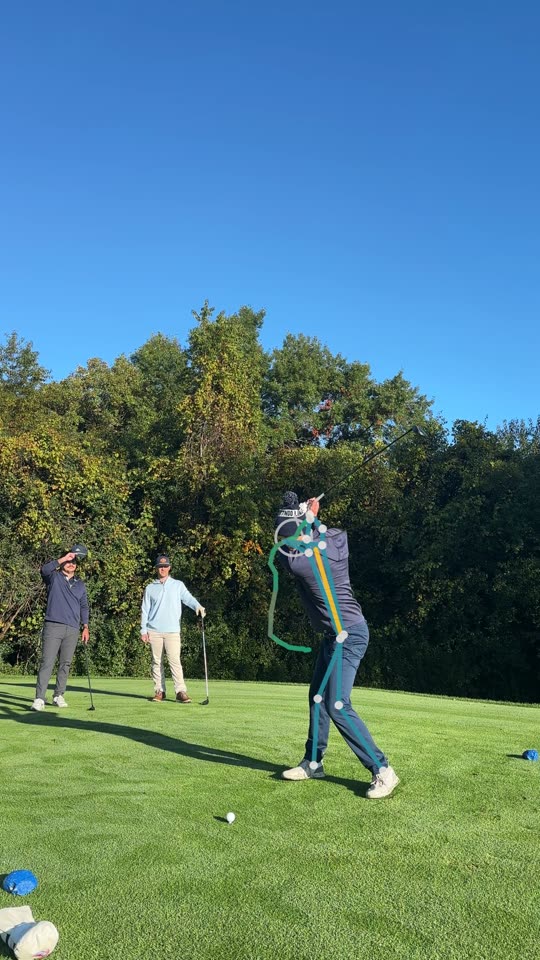 Zac / Driver / Top of backswing
Centered and quiet on the way back, then he stands up through the strike.
AI opinion, not an official handicap.The short version
What he misses, why, and what to do about it.
The miss
His driver finishes right.
Two drives filmed on a launch monitor finished 26 and 20 yards right of the target, and both were still curving right. Distance is not the problem: they carried 279 and 283 yards.
Why
He stands up through the strike.
He starts bent 26° toward the ball and has lost 11° of that by impact, and his hips finish 6 cm closer to it. With no room left, his hands get pushed out and up, and from there the clubface tends to arrive open. The camera measures his body, not the clubface, so that last link is our read.
The drill
The chair drill.
A chair or the golf bag, set so it just touches his backside at address. Slow half swings with a 7 iron, touching it all the way down and through. 3 sets of 8 with no ball, then 10 balls at half speed.
The feel: back pockets stay on a wall behind you until the ball is gone.
How he will know
More drives start left of a stick.
An alignment stick in the ground three or four paces in front of the ball, on the target line. Ten drivers at 70 percent, counting how many start left of it. On a launch monitor the pass is an average inside 10 yards of the target, with misses on both sides.
Why a ball that starts right and curves right does thatAll three priorities, with the numbers
Where this swing is headed
Finished, this is a fairway finder: a swing that looks unhurried and still carries the ball past people who swing harder. He already has the distance. The work is keeping the bend he starts with, so the same swing sends the ball at the target.
A coaching opinion about the kind of swing this is. It is a direction, not a forecast.
Slow motion
Watch it happen.
Four of his swings, filmed at 120 frames a second. Drag across the picture to move through one.
His hands going backHis hands coming down

Drag to move through the swing
0.98seconds before impact
Address
Set up, bent 26° forward from the hips. The white line marks where his hips start. The ring marks his head.
- Forward bend
- 26°
- Hips toward the ball
- 0 cm
- Head higher than address
- 0 cm
The numbers and the body lines stop at impact. We do not measure the follow-through.
Zac's coaching dossier
Three priorities. A plan to test.
These priorities and stroke costs are AI coaching opinions from six clips and one launch monitor session. They are ideas to test, not measured strokes lost and not a promise.
Explore the comparison and three-week plan
Driver vs iron: two club habits
| Metric | Driver | Iron | What it says |
|---|
The plan
Three weeks, every drill tied to a number
What he already owns
The swing family, in more detail
Open Zac's full interactive report Film, 3D model, telemetry, grades and share card
Film room
Every frame, tracked
Teal skeleton, yellow spine axis, grey ghost = where he started. The hand trail heats from green to red as speed climbs.
360 orbit
Walk all the way around his swing
A model-derived 3D skeleton estimated from the phone video. Depth can be wrong, especially from face-on. Drag to orbit, scrub to move through the swing. Gold = hips, teal = shoulders: the gap between them is the coil.
Telemetry
The numbers under the swing
Hand speed through the swing
Lead/trail hand midpoint, m/s, scaled to a 6'0" frame. Bands mark each phase.
Tracked measurements and reference ranges
| Metric | Clip | Zac | Reference window | Read |
|---|
Report card
A grade, with the evidence beside it
OVERALL
The newer dossier treats face-on knee flex as a camera artifact. Use that view-specific interpretation when reading the original setup grade. Experimental scores and reference windows are not independently validated.
Uncharted
Five experimental movement scores
The handicap read
Estimated handicap
A swing-based guess, not a verified playing index. Clubhead speed and carry below are coaching estimates, not launch-monitor measurements.
The roast
The roast
Delivered with love. Share responsibly.
One camera.
A useful view, with limits.
We show the evidence and say where it runs out. A grade is a coach's opinion, not a launch monitor.
What it can show
- Positions through the swing. Address, the top and impact, found frame by frame.
- Visible movement. Joint angles, projected head rise, sway and posture from the right view.
- Patterns worth testing. A tracked replay, a grade and a starting point for practice.
What it cannot promise
- True club or ball data. No measured clubhead speed, spin, carry, pressure or impact force.
- Reliable depth from every angle. Face-on rotation is unreliable. Down-the-line 3D is still a model estimate.
- Your playing handicap. The guess is not an official index and has not been calibrated against a large player set.
Read the method and sources of uncertainty
Tracking. Zac's offline report uses YOLO11-x pose with 17 joints on each frame, isolating the golfer from onlookers, plus MediaPipe Heavy for a model-derived 3D skeleton. Swing phases come from hand motion and height. The browser Lab uses MediaPipe Full and the shared grading engine; it does not perform Zac's separate AI key-frame review.
Measurement. Angles and distances come from tracked joints and depend on camera position and tracking quality. Zac's distances assume a 6'0" height; the Lab uses your selected height. Speeds are projected hand speeds, a lower-bound estimate, not clubhead speeds. Zac's first driver clip is 24 fps, too slow to time a swing, so this page no longer quotes a tempo for him.
Judgment. Grok reviewed Zac's raw and tracked key frames alongside the metrics. Its grades, flight interpretations, stroke costs and drills remain coaching opinions. Reference ranges and the handicap formula need independent calibration. Use the right camera view and review important changes with a qualified golf coach.
Want one about your swing?
Available on iPhone.